
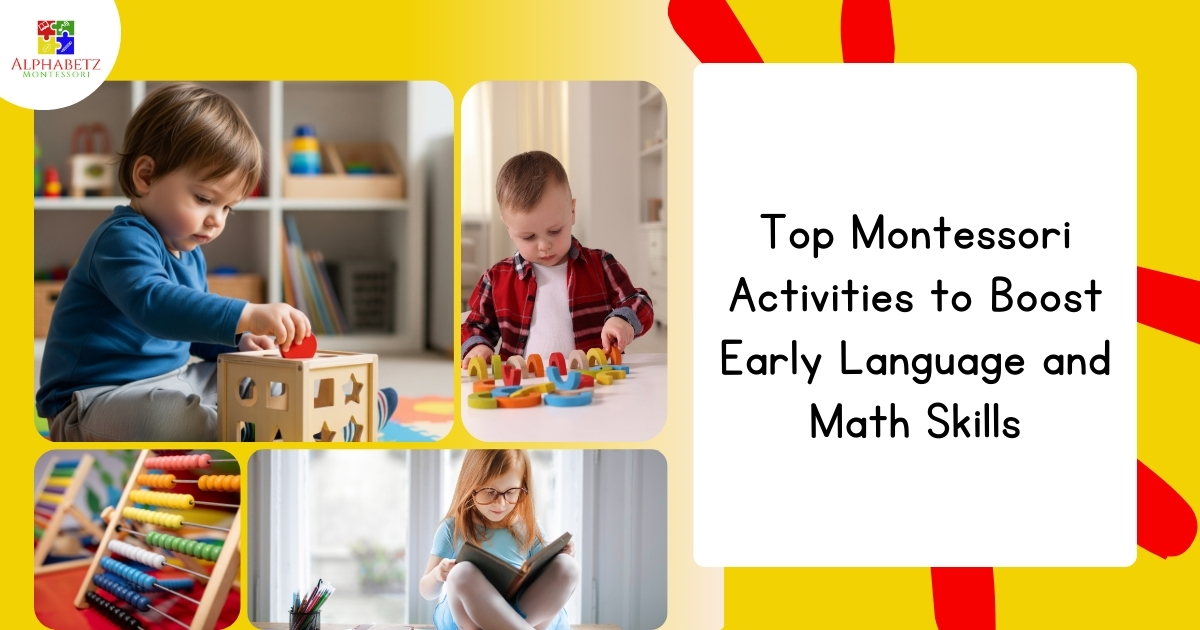
Early childhood is the most important stage for building strong language and math foundations. At Alphabetz Montessori, we follow the Montessori philosophy that children learn best through hands-on, purposeful activities that nurture curiosity, independence, and confidence.
Montessori activities support early language development and math skills by engaging multiple senses and allowing children to learn at their own pace. Here are some of the top Montessori activities that help children develop these essential skills naturally and joyfully.
1. Sandpaper Letters for Early Language Development
Sandpaper letters help children recognize letter sounds through touch and movement. By tracing each letter while saying its sound, children connect visual, auditory, and tactile learning.
This multisensory approach strengthens phonics skills, improves memory, and prepares children for reading and writing at an early age.
2. Practical Life Activities That Build Vocabulary
Activities like pouring water, folding clothes, cleaning surfaces, and food preparation play a key role in language development. Teachers introduce descriptive vocabulary such as empty, full, smooth, heavy, and light.
These experiences help children understand language in real-life contexts while improving concentration, coordination, and independence.
3. Object-to-Picture Matching for Language Skills
Matching real objects with picture cards strengthens word recognition and comprehension. Children learn that words and images represent real-world items, which supports early reading readiness.
This Montessori activity improves vocabulary, visual discrimination, and cognitive development.
4. Number Rods for Understanding Quantity
Number rods introduce children to numbers 1–10 using physical materials of varying lengths. Children learn to compare sizes and understand numerical order through hands-on exploration.
This activity builds a solid foundation for math concepts like quantity, sequencing, and measurement.
5. Counting with Concrete Materials
Counting beads, buttons, shells, or blocks helps children understand one-to-one correspondence. This is a crucial early math skill that connects numbers with actual quantities.
Children gain confidence in counting while developing logical thinking and problem-solving abilities.
6. Sound Games to Develop Phonemic Awareness
Sound games encourage children to identify beginning, middle, and ending sounds in words. These games build listening skills and phonemic awareness—key elements for reading success.
Because sound games are interactive and playful, children enjoy learning without pressure.
7. Spindle Boxes for Number Recognition
Spindle boxes teach number recognition, counting accuracy, and the concept of zero. Children place the correct number of spindles into labeled compartments, reinforcing math skills through repetition and focus.
This activity also enhances attention, order, and self-correction.
8. Classified Cards and Storytelling
Classified cards introduce vocabulary related to animals, plants, transportation, and everyday objects. Children learn to categorize, describe, and form sentences, strengthening expressive language skills.
Storytelling further enhances imagination, sentence structure, and communication.
Why Montessori Activities Work
Montessori education emphasizes learning through experience rather than memorization. By using hands-on materials and child-led exploration, children develop strong early language and math skills that support lifelong learning.
At Alphabetz Montessori, we create a nurturing environment where children grow academically, socially, and emotionally, building a love for learning that lasts a lifetime.
